

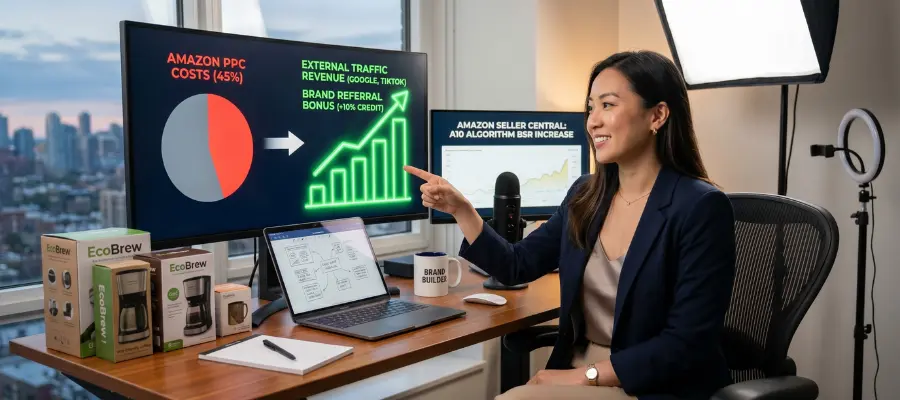
For years, the formula for success on Amazon was simple: optimize your listing, bid on the right keywords within Seller Central, and wait for the flywheel to spin. If you had a decent product and a functional PPC (Pay-Per-Click) strategy, you were in the game. But as we move through 2026, that game has fundamentally changed. The Amazon marketplace is no longer a walled garden where internal ads are enough to maintain dominance.
Today, the cost per click within Amazon has reached an all-time high, often eating up 30% to 50% of a seller's margin. Meanwhile, Amazon’s A10 algorithm has become increasingly sophisticated, prioritizing "off-platform signals" more than ever before. If you are only advertising inside Amazon, you are competing in the most expensive auction on the internet. The real winners are now looking outward, driving traffic from Google, TikTok, and niche blogs to "hack" their way to the top of the search results.
Why External Traffic Outperforms Internal PPC: The Data Behind the Claim
When a customer finds your product through an Amazon Sponsored ad, Amazon records a standard commercial transaction. When that same customer arrives from an external source — a Google search, a niche blog, or an influencer recommendation — and then completes a purchase, the algorithm interprets it differently. It reads external converting traffic as a market validation signal: evidence that your brand has demand beyond Amazon's own paid ecosystem.
This isn't theoretical. Amazon's current ranking system, widely referred to as A10 among sellers and agency analysts, explicitly weights off-platform signals more heavily than its predecessor did. According to data published by Canopy Management, which manages over $3.3 billion in partner revenue, the weight Amazon places on external converting traffic has grown measurably year over year — and in 2026, sellers who bring outside traffic that converts consistently report faster climbs in organic rank for competitive keywords than those relying solely on PPC.
The financial math reinforces this further. A straightforward comparison using the Bonus-Adjusted CAC formula illustrates the gap:
- Amazon PPC: A keyword priced at $4.50 CPC with an 8% conversion rate costs $56.25 per sale.
- Google Ads (same keyword): The identical keyword on Google costs $1.80 CPC. At a 5% conversion rate, that's $36.00 per sale. Apply a 10% Brand Referral Bonus on a $35 average order value ($3.50 credit), and your adjusted cost drops to $32.50 per sale — roughly 42% cheaper than the Amazon PPC route.
One important caveat that many sellers overlook: the ranking boost only applies to converting external traffic. As Canopy Management's 2026 algorithm analysis notes, "traffic that bounces tells the algorithm the opposite story." Sending volume without intent — via incentivized clicks, irrelevant audiences, or low-quality sources — can actively suppress your organic standing rather than improve it. The advantage of external traffic is real, but it is entirely dependent on targeting quality over quantity.
A further compounding benefit is the "branded search" effect. Users who discover your product on TikTok or a blog often go to Amazon and search for your brand name directly. This branded search behavior is among the strongest ranking signals Amazon's algorithm can receive — it indicates market leadership and triggers organic visibility gains for high-volume non-branded keywords, something no internal PPC campaign can replicate on its own.
The Financial Edge: Understanding the Brand Referral Bonus
One of the most compelling reasons to drive external traffic is purely financial. Amazon actively subsidizes your off-platform marketing efforts through the Brand Referral Bonus program. This isn't a small perk; it is a fundamental shift in how Amazon shares the cost of customer acquisition with its sellers.
On average, Amazon credits sellers with a 10% bonus on the sales price of any product sold through external traffic. This bonus is deducted from your referral fees, which effectively means you are getting a massive discount on Amazon's commission. If you spend $1.00 on a Google ad that results in a $100 sale, Amazon effectively hands you back $10. In many high-margin categories, this bonus can cover a significant portion of your external advertising costs, making your total customer acquisition cost (CAC) much lower than traditional PPC.
Breaking Down the Math
Consider a product priced at $50 with a 15% referral fee ($7.50). If you sell this through an internal PPC ad with a $1.50 CPC and a 10% conversion rate, your ad cost per sale is $15.00. Your net after fees and ads is $27.50.
Now, if you drive that same sale through an external link using the Brand Referral Bonus, you earn a 10% bonus ($5.00). Even if your external ad cost is the same, your net increases to $32.50. Over thousands of units, this difference determines who can afford to scale and who gets squeezed out of the market.
The Algorithmic Shift: A10 and the Power of Shopping Signals
In early 2026, Amazon refined its ranking algorithm to place a heavier emphasis on "Shopping Signals." While the old A9 algorithm focused heavily on sales velocity and text relevancy, the current iteration looks at the quality and source of the traffic. Amazon wants to see that your brand has "gravity"—meaning people are looking for you specifically, not just stumbling upon you in a search result.
When you drive traffic from TikTok or a niche editorial site, you are generating brand-name searches. Users often see an ad, go to Amazon, and type your specific brand name into the search bar. This "branded search" is the ultimate ranking signal. It tells Amazon that you are a market leader, which triggers a massive boost in your organic ranking for non-branded, high-volume keywords.
Furthermore, external traffic helps diversify your "traffic profile." Relying 100% on Amazon PPC makes your listing vulnerable to competitors who might outbid you. By having a steady stream of customers coming from Google or social media, your sales velocity remains stable even if your PPC campaigns underperform for a few days.
The "Middle Man" Strategy: Why You Shouldn't Link Directly to Amazon
A common mistake many sellers make is sending traffic directly from an ad to their Amazon listing. While this seems efficient, it often leads to a lower conversion rate because social media traffic is usually "cold." A user scrolling through Instagram isn't necessarily in a "buy now" mindset compared to someone searching on Amazon.
The most successful sellers in 2026 use an intermediary step—often called a Landing Page or a "Bridge Page." This serves three critical purposes:
- Filtering Traffic: A landing page ensures that only people truly interested in buying click through to Amazon. This protects your Amazon conversion rate, which is a vital ranking metric.
- Data Collection: You can embed a Facebook Pixel or Google Tag on your own landing page. Amazon doesn't give you this data. By owning the "middle," you can retarget people who didn't buy.
- Email Acquisition: You can offer a small discount code in exchange for an email address. This allows you to build a customer list that you own, giving you a way to launch future products without spending a dime on ads.
Leveraging the Power of "Rufus" and AI Search
With the rollout of Rufus, Amazon’s AI-powered shopping assistant, the way products are discovered has shifted from "keyword matching" to "contextual understanding." Rufus doesn't just look at your bullet points; it scans the broader web to see what experts and customers are saying about your category.
If your product is mentioned in a "Top 10" list on a reputable blog or discussed in a viral thread on Reddit, Rufus is more likely to recommend your product when a customer asks a complex question like, "Which espresso machine is best for a small apartment but still makes professional-grade foam?" By driving external traffic and generating mentions across the web, you are essentially "feeding" the AI the data it needs to prioritize your listing over a competitor who only exists within the Amazon bubble.
Common Pitfalls: What to Avoid in 2026
Driving external traffic is powerful, but it is also unforgiving. The same algorithm that rewards high-quality external signals will penalize low-quality ones. Here are the most consequential mistakes to avoid:
1. Not Using Amazon Attribution Links
If you are not tagging every external link with Amazon Attribution, you are operating blind. You will have no visibility into which channel, ad, or influencer post generated a sale — and more critically, you will forfeit the Brand Referral Bonus entirely. Every external campaign, from a Google Ad to a micro-influencer's bio link, must pass through an Attribution tag. This is non-negotiable infrastructure, not an optional add-on.
2. Sending Low-Intent or "Garbage" Traffic
High click volume with low purchase intent is one of the fastest ways to damage your organic ranking. When Amazon sees that a large number of sessions on your listing ended without an add-to-cart or purchase, it interprets this as a negative conversion signal. Your listing effectively gets flagged as one that fails to satisfy buyer intent — which suppresses your position in organic results even if your PPC campaigns are performing well.
This includes paid "click farm" traffic, irrelevant Facebook group promotions, and broad social media campaigns aimed at audiences who have no purchase intent for your category. The fix is upstream: tighten your audience targeting before any traffic reaches Amazon, use a landing page to filter out browsers from buyers, and track conversion rate at the session level inside Seller Central to catch problems early.
3. Skipping the Landing Page (and Losing Your Own Data)
Sending external traffic directly to your Amazon listing is the single most common and costly shortcut sellers take. Social media audiences are typically "cold" — they are scrolling, not shopping. Dropping them directly onto a product page without any warm-up results in poor conversion rates, which feed directly into Amazon's ranking logic as a negative signal.
A landing page solves two problems simultaneously. It filters non-buyers before they reach your listing (protecting your conversion rate), and it gives you a surface to collect first-party data — email addresses, retargeting pixels, and behavioral signals — that Amazon will never share with you. Every seller who skips the landing page is handing that data permanently to Amazon instead of building their own customer asset.
4. Ignoring Mobile Experience
Over 70% of external traffic arrives on a mobile device. If your landing page loads slowly, your Amazon listing's hero image doesn't communicate the product's value proposition at thumbnail size, or your checkout experience requires pinching and zooming, you are losing conversions at the exact moment buyer intent peaks. Amazon evaluates mobile performance as a distinct signal — a listing can be underperforming specifically on mobile without that weakness being obvious in aggregate metrics. Audit your listing on a phone, not just a desktop.
5. Treating External Traffic as a Launch Tactic, Not a System
Many sellers turn on an influencer campaign or a Google Ads test, see a BSR lift, and then stop. The ranking gains from external traffic compound over time but also decay when the signal disappears. Amazon's algorithm interprets a sudden spike followed by silence as artificial velocity — not genuine market demand. The sellers who capture lasting organic rank improvement are those who maintain a consistent, ongoing stream of converting external traffic, even at modest volume, rather than relying on periodic bursts.
The Influencer Equation: Micro-Influencers vs. Mega-Stars
In the current landscape, the era of paying "mega-influencers" thousands of dollars for a single post is largely over for mid-sized Amazon brands. The ROI is almost always better with "Micro-Influencers"—people with 5,000 to 50,000 highly engaged followers in a specific niche.
These influencers have a much higher trust factor. When a specialized vegan chef recommends a specific blender, their audience listens. In 2026, the strategy is about "seeding"—sending products to dozens of micro-influencers rather than betting on one big name. This creates a consistent drumbeat of external traffic and social proof that Amazon’s algorithm loves.
Practical First Steps for Sellers
If you haven't started driving external traffic yet, don't try to master everything at once. Start with one channel. For most, Google Search Ads is the easiest transition because the intent is similar to Amazon. People searching Google for "best waterproof hiking boots" are ready to buy.
Once you have a baseline of Google traffic, move to a "Social-to-Landing-Page" funnel. Use TikTok or Instagram Reels to show the product in action, drive them to a simple bridge page that offers a 10% coupon, and then send them to Amazon to complete the purchase. This "Warm-Up" process ensures that when they hit your Amazon listing, they are ready to hit "Add to Cart."
How AmzMonitor’s BSR Tracking Empowers Your Strategy
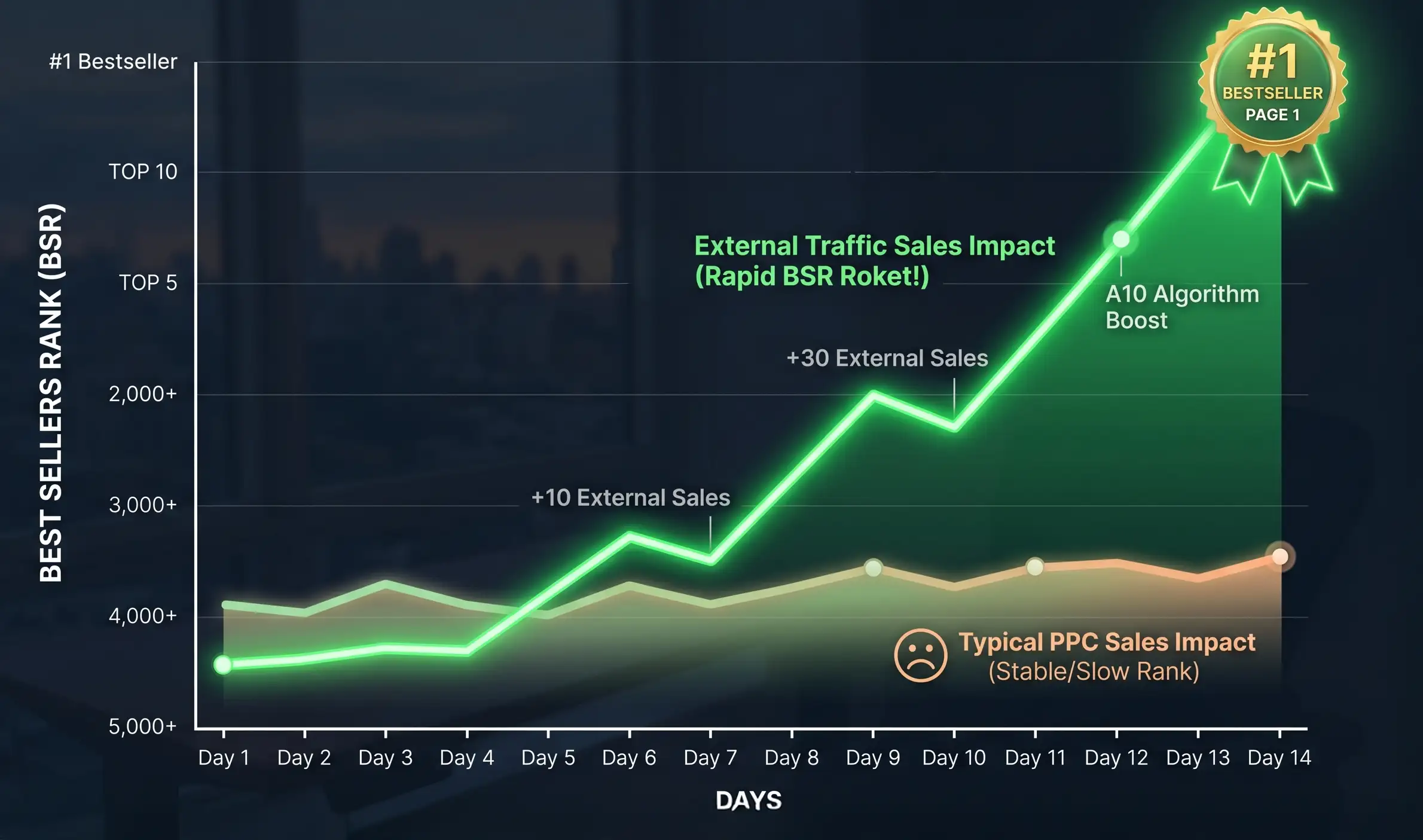
Understanding the theory behind external traffic is one thing, but reacting to its impact in real-time is what separates the top 1% of sellers from the rest. Best Seller Rank (BSR) is the ultimate heartbeat of your product’s demand and market position. Since a lower rank directly translates to higher sales performance, tracking every shift in your ranking—across every category listed on your detail page—is essential for benchmarking against competitors and making informed inventory decisions.
This is where AmzMonitor’s Best Seller Rank Alerts become your most valuable asset. The platform continuously monitors your BSR and sends instant notifications whenever there is a significant change, allowing you to see the immediate "algorithm boost" your external traffic campaigns are generating. You can even set specific thresholds to ensure you only get alerted for the moves that matter most to your bottom line, while every single fluctuation is recorded for deep-dive analysis on your Alerts page. Don’t just guess if your strategy is working—monitor it with precision and react before the competition even notices the shift.
Building a Defensible Moat
Ultimately, the reason external traffic is "2x more valuable" is that it helps you build a brand, not just a listing. In a world where Chinese factories can copy your product and undercut your price in weeks, your only real protection is brand equity. If people are looking for you by name because they saw you on their favorite blog or social feed, a cheaper competitor doesn't matter.
Amazon is increasingly a "pay-to-play" platform, but they have left the back door open for sellers who are willing to do the work of bringing in their own customers. By mastering external traffic now, you aren't just surviving the 2026 landscape—you are future-proofing your business against the next five years of changes.
The transition from a "seller" to a brand happens the moment you stop waiting for Amazon to give you customers and start bringing them yourself. It’s more work, yes, but the rewards—lower fees, higher rankings, and true business longevity—make it the only viable path forward in the modern marketplace.