

Every Amazon seller knows the feeling of a sudden sales spike. Whether it comes from Prime Day, Black Friday, Q4 holiday shopping, or an unexpected viral moment on TikTok, watching orders stack up faster than the dashboard can refresh is genuinely exciting. Revenues hit record highs, your Best Sellers Rank (BSR) climbs, and the business looks strong.
Experienced sellers, though, view these spikes with a degree of caution. A major sales surge is a double-edged sword. While the revenue is real, so is the operational pressure that follows. The real test of an Amazon business does not happen during the peak—it happens in the weeks after, when the dust settles and the consequences of that volume start to surface.
Every sales surge creates two opportunities. One for you—and one for your competitors.
When your product reaches the top of search results, you are no longer running a quiet, profitable listing. You have placed a target on your back. Amazon's ranking systems, thousands of new customers, strained logistics networks, and competitors watching for weakness are all paying attention. Understanding how post-surge cycles unfold is the first step to navigating them without losing ground.
How a Sales Surge Becomes a Liability
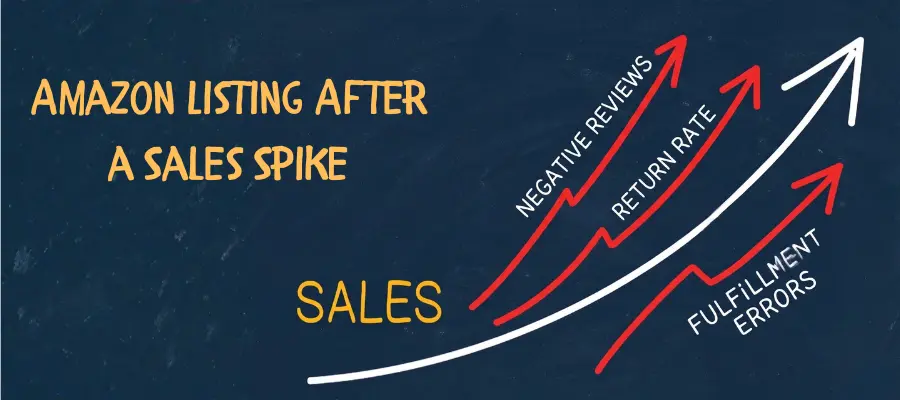
A breakdown in one area of your Amazon operation tends to trigger problems elsewhere. The sequence below shows how a temporary spike in velocity can turn into a listing vulnerability if left unmanaged:
- Sales Surge: High order volume strains both fulfillment infrastructure and your own supply chain.
- Logistics Pressure: Fulfillment networks slow down, and processing errors increase.
- Customer Friction: Shipping delays and warehouse mistakes reach buyers.
- Negative Reviews: Frustrated customers leave public feedback that damages your listing.
- Conversion Drops: New negative reviews reduce buyer confidence and click-through.
- Ranking Loss: Amazon's algorithm demotes listings with declining conversion rates.
- Competitor Attacks: A weakened listing attracts hijackers and bad-faith catalog edits.
- Recovery: Systematic auditing and corrective action to reclaim lost ground.
Knowing where you are in this cycle lets you get ahead of problems before they show up in your 30-day performance metrics. Here is how each phase tends to play out.
The Dangerous Calm
In the days immediately after a major sales event, everything looks fine. Conversion rates are up, organic rankings are climbing, and cash flow is healthy. This is also the moment when many sellers stop paying close attention—which is exactly when they should be auditing.
Underneath those green metrics, hundreds or thousands of orders are now in transit. Each one is a potential problem: a delayed package, a warehouse error, a damaged item. The feedback from those orders will start arriving soon, and by then it is often too late to get ahead of it.
What to Monitor:
✓ Pending FBA Orders: Look for unusual delivery backlogs.
✓ Inbound Shipments: Confirm backup inventory is moving to avoid stockouts.
✓ Buyer Messages: Watch for early patterns in pre-delivery questions.
The Logistics Pressure
During high-volume periods, Amazon's fulfillment network operates under significant stress. That stress shows up as misrouted packages, transit damage, and slower processing times.

One of the more damaging issues is what happens with returns. When return volume spikes, warehouse staff working under pressure sometimes mark items as fulfillable without properly inspecting them. A broken, opened, or incomplete unit goes back into active inventory and ships to the next buyer—who then blames your brand for receiving a defective product. This is a direct path to Product Condition Complaints and negative reviews that have nothing to do with your actual product quality.
What to Monitor:
✓ Return Processing Reports: Look at the stated reasons for returns.
✓ Voice of the Customer (VOC): Check your CX Health score daily.
✓ Carrier Delays: Identify regional bottlenecks before buyers escalate.
The Customer Reaction
Logistics problems eventually become public record on your product detail page. A buyer who receives an open-box return, a damaged package, or a late delivery is likely to leave a 1-star review—and those reviews compound quickly after a high-volume event.
A drop from a 4.7 to a 4.4 star rating might look minor, but it has a real effect on buyer behavior. Shoppers reading recent negative reviews about shipping or product condition click away. Your unit session percentage falls, and Amazon's algorithm notices.
What to Monitor:
✓ New Reviews: Watch for clusters of 1-star or 2-star ratings appearing together.
✓ Listing Conversion Rate: Track daily changes in unit session percentage.
✓ Seller Feedback: Remove feedback that relates solely to FBA shipping errors.
When the Algorithm and Competitors React
Amazon's A9 algorithm tracks conversion rate relative to category peers in real time. When your rate drops, the algorithm interprets it as a signal that your listing is underperforming and begins moving you down the search results—reducing the organic traffic that drives most listings' revenue.
A falling rank makes you more visible to the wrong audience: competitors and bad actors who have been watching your BSR climb. If you go out of stock, hijackers will attach to your ASIN via the Buy Box and sell inferior or counterfeit versions to buyers who think they are buying from you.
Beyond stockouts, competitors may also submit false catalog edits to reclassify your product into an unrelated or adult category, swap your main image for something that violates Amazon's policies, or inject prohibited keywords into your backend search terms to trigger an automatic listing suspension. These tactics are more common than most sellers expect.
What to Monitor:
✓ Buy Box Percentage: Any drop below 100% warrants immediate investigation.
✓ Listing Details: Audit your title, main image, and category daily.
✓ Keyword Indexing: Check whether your core search terms are losing organic rank.
Getting Back on Track
Recovery is not a single action—it is a process of closing the gaps that the surge exposed. Start with your reviews. Identify whether the negative feedback points to a logistics issue, a product quality issue, or a one-time warehouse error. The answer changes what you do next. Packaging problems need to be fixed at the source. FBA-related complaints may qualify for removal through Brand Registry. Feedback driven by a competitor attack requires a different response entirely.
On the listing side, run a full audit of your title, images, category, and backend keywords to confirm nothing has been altered. If your keyword rankings have dropped, rebuilding organic visibility through a targeted PPC campaign is usually faster than waiting for the algorithm to self-correct.

Manual checks are workable for sellers with a small catalog, but as SKU count grows, the volume of daily changes makes it harder to catch problems in time. Whatever your approach, the goal is the same: compress the window between when something goes wrong and when you find out about it.
The Month After the Surge Determines the Winner
A major sales event is a good problem to have—but the revenue it generates can disappear quickly through high return costs, rank recovery spending, and listing health issues that take weeks to resolve.
The sellers who hold their ground after a spike are not necessarily the ones who drove the most traffic during it. They are the ones who were paying attention to their listings, their inventory, and their catalog integrity while everyone else was watching the sales counter.
Smart sellers prepare for Prime Day. Great sellers prepare for the month after it.