

Starting February 12, 2026, Amazon is changing how reviews are shared across product variations to improve accuracy, increase customer trust, and help shoppers make better-informed purchasing decisions. While this update is designed to reduce misleading feedback and potentially decrease returns, it also introduces new operational risks for sellers managing complex variation structures.
At AmzMonitor, we’ve been working closely with agencies and brands to understand how this change affects real-world catalogs. As a result, we’ve introduced a new monitoring capability that detects early warning signals when review sharing breaks — allowing teams to act before performance damage becomes visible.
Amazon’s official position is clear: Star ratings and review counts should accurately reflect the specific product a customer is considering. Historically, reviews have often been shared across all child ASINs within a variation — even when those variations differ in ways that meaningfully impact performance, usability, or customer experience. This has created situations where customers read reviews that don’t truly apply to the exact product they are about to buy.
The new review sharing guidelines aim to ensure that reviews remain product-specific whenever functionality or experience differs, while still allowing shared reviews where differences are genuinely minor.
What Changes Between February 12 and May 31, 2026
Between February 12, 2026, and May 31, 2026, Amazon will gradually update how reviews are shared — category by category.
Under the new rules:
- Reviews will only be shared when variations have minor differences that do not impact core functionality
- Reviews will stop appearing on variations with significant functional, experiential, or specification differences
- Child ASINs within the same parent may begin showing different review counts and star ratings
Sellers will receive an email notification 30 days before the change affects their products, but the exact enforcement behavior may still vary by category and listing structure.
How Amazon Decides Whether Reviews Are Shared
Rather than relying solely on variation labels or themes, Amazon evaluates whether differences between products meaningfully change how the product functions, is used, or is experienced by the customer. The core question Amazon asks is simple: Would a review for one variation accurately represent another variation from a customer’s perspective?
Reviews are generally shared when variations differ only in ways that do not affect the core product experience, such as:
- Visual-only differences like color or pattern
- Size or dimension changes that maintain the same function (for example, different shelf heights or bedding sizes)
- Pack size or quantity differences
- Secondary scent variations where scent is not the primary purchase driver
- Fitment differences for the same product type (such as phone cases or auto parts designed for different models)
In these cases, Amazon considers the customer experience sufficiently similar for reviews to remain relevant across variations.
Reviews are typically not shared when differences impact performance, compatibility, or intended use, including:
- Changes in power, speed, memory, or performance specifications
- Appliances where size affects power output or usage behavior
- Products designed for different platforms, operating systems, or ecosystems
- Different models or generations within the same product line
- Bundles or kits that add accessories and change value or usage
- Differences in flavor, ingredients, or formulation
- Products where scent is a primary buying factor
- Variations with different fit types, special sizing, or material composition
- Design changes that materially affect appearance, durability, or perceived value
- Products intended for different user profiles, skill levels, or use cases
In these scenarios, Amazon treats the variations as functionally distinct products, meaning shared reviews would no longer provide accurate guidance to customers.
Why These Guidelines Create Real Risk for Sellers
On paper, Amazon’s review sharing guidelines are logical and customer-focused. In practice, however, they introduce a high level of uncertainty for sellers. Many variation families currently live on Amazon were created years ago under looser enforcement standards, and even listings that appear well-structured today can fall into gray areas under the new interpretation.
A difference that feels minor or cosmetic to a seller may be classified as functional by Amazon’s systems. Some categories may enforce the guidelines more aggressively than others, and in many cases, enforcement can occur without any visible change to the listing itself. When Amazon determines that reviews should no longer be shared, the first and often only visible signal is a sudden review count change on one or more child ASINs.
This is where the real danger begins. In a healthy variation family, child ASINs typically display identical review counts, creating consistency that supports customer trust and strong conversion performance. When review sharing breaks, that balance is disrupted. One child ASIN may retain strong social proof while another suddenly appears weak or unproven, even though the products are closely related. Customers naturally gravitate toward the variation with higher perceived credibility, causing conversion rates on the affected child to drop. Over time, this leads to slower sales velocity, declining organic rank, and reduced advertising efficiency.
What makes this especially risky is that the entire process often happens silently. There is usually no clear system message explaining why reviews have separated, leaving sellers to discover the issue only after performance has already been impacted.
AmzMonitor's Role in This Process
Amazon expects sellers to maintain clean and compliant variation structures, but doing this reliably at scale is unrealistic. Changes to how ratings and reviews are shared across variations often occur without clear warnings, and sellers typically notice an issue only after conversions and sales begin to decline.
AmzMonitor solves this by monitoring what sellers cannot track manually: review behavior at the ASIN level. When review counts suddenly decrease, AmzMonitor flags the change immediately — a strong signal that parent–child review sharing may have been disrupted.
AmzMonitor addresses this gap by monitoring what sellers cannot reliably track manually: rating and review behavior at the ASIN level. When the total rating count or written review count unexpectedly decreases, AmzMonitor flags the change immediately — a strong signal that ratings and reviews may no longer be shared across a variation family. Sellers receive an early, measurable alert. This allows teams to quickly identify affected variation groups, review listing structures, and take corrective action before visibility, trust, and revenue are impacted.
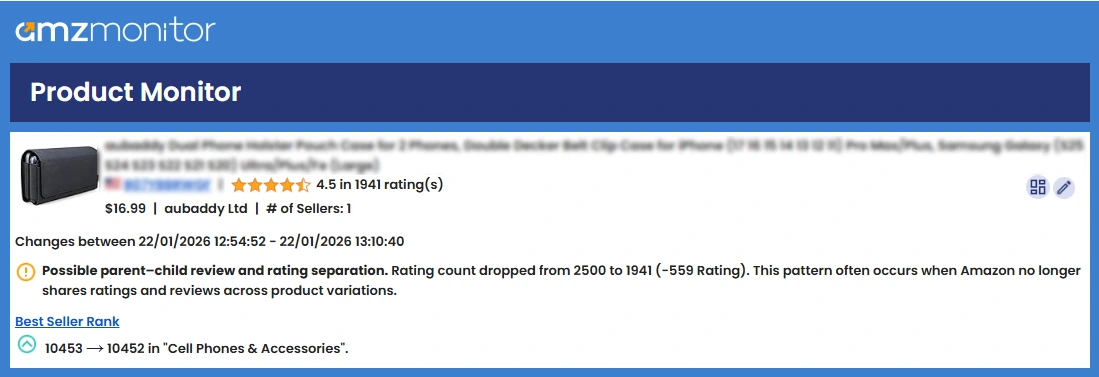
While this feature is particularly valuable during Amazon’s 2026 review-sharing updates, its purpose goes beyond a single policy change. Rating and review separation can be triggered by variation relationship changes, category reclassification, backend listing edits, or temporary Amazon system behavior — often without any visible notification.
AmzMonitor continuously monitors rating and review count behavior to surface these risks early, functioning as an ongoing variation health safeguard rather than a one-time compliance check. The system is intentionally designed as a first layer of protection, delivering high-confidence alerts, minimizing false positives, and providing actionable signals across large product catalogs. As Amazon’s enforcement patterns evolve and real-world data accumulates, AmzMonitor will continue refining and expanding its variation-level monitoring capabilities.
Final Thoughts
Amazon’s review sharing update is designed to improve trust and accuracy for customers — but it introduces real operational risk for sellers. In a marketplace where small review changes can have outsized financial impact, proactive monitoring is no longer optional. By focusing on meaningful behavioral signals rather than assumptions, AmzMonitor helps sellers and agencies detect problems early — before performance damage becomes expensive and difficult to reverse.