

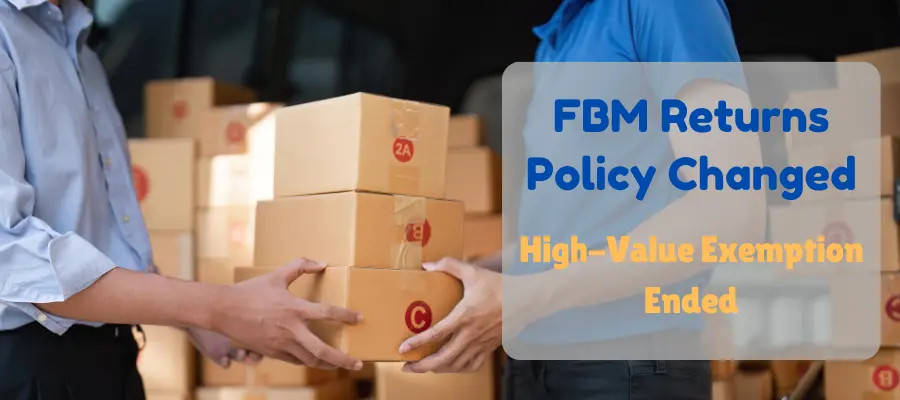
If you're handling your own fulfillment on Amazon, February 8, 2026 brought a policy change that's going to hit your wallet. Amazon just eliminated the high-value exemption for prepaid return labels. What does that mean? Every single return on your seller-fulfilled orders now goes through Amazon's automated prepaid label system—whether you're selling a $20 phone case or a $2,000 camera.
For years, FBM sellers had a safety net for expensive items. You could opt out of the automatic prepaid labels and handle returns yourself. That meant choosing your own carrier, adding insurance, requiring signatures—basically protecting yourself when expensive stuff came back. That safety net? Gone.
This only affects FBM sellers. If you're using FBA, Amazon was already handling your returns anyway, so nothing changes for you. But if you're managing your own fulfillment, you need to understand what just changed and how to protect yourself.
The Old Way vs. The New Way
Here's what you lost. Items over $100 used to qualify for a high-value exemption. You could manage those returns yourself—pick FedEx with full insurance, require signature confirmation, whatever made sense for protecting a $1,500 laptop or professional camera gear on its way back to you.
The timeline was also more forgiving. You had 14 days from when the customer hit "return" to when the refund went through. Enough time to actually communicate with the buyer, arrange proper shipping, make sure things were handled right.
That communication step also worked as a natural filter. When customers knew they had to actually talk to you before shipping something back, they'd think twice about whether the return was really necessary. Not anymore.
Now it's completely automated. Customer clicks return, Amazon instantly generates a prepaid label, customer prints it and drops it at UPS or USPS. Done. No seller approval needed. No discussion. And the refund timeline just got cut in half—you've got 7 days now instead of 14.
For sellers in categories like electronics, jewelry, cameras, and designer goods, this is a particularly rough change. These are exactly the categories where both item values and fraud risk run highest.
What This Actually Costs You
Amazon calculates return shipping based on the weight and dimensions in your product listing. A typical 2-pound item will run you $8-12 in return shipping. Doesn't sound terrible until you do the math. If you're working on 25% margins and a customer returns a $50 item, that $10 shipping charge just ate 20% of your profit. And that's before you factor in your time or whether you can even resell the item at full price.
Heavier items scale up fast. A 10-pound package could cost you $15-25 to ship back. Some sellers have already started pulling products from Amazon entirely when the return label costs just don't make sense anymore. If buyers want those items, they're going to have to find them somewhere else.
And you can't negotiate these rates. Amazon picks the carrier, picks the service level, charges whatever they charge, and deducts it from your account. You're stuck with whatever deal Amazon has with UPS and USPS.
The Insurance Problem
Here's the kicker that really hurts on expensive items: Amazon's prepaid labels only include $100 of insurance coverage. Selling a $2,000 camera? If UPS loses it on the way back to you, that insurance covers 5% of your loss. And SAFE-T—Amazon's seller protection program—doesn't cover items lost or damaged in return transit. You have to file claims with the carrier yourself, and anyone who's dealt with carrier claims knows that's not exactly a reliable way to recover thousands of dollars.
You used to be able to insure returns for their full value when you controlled the shipping. Now you're just exposed.
Return Fraud Just Got Easier
Wardrobing—where customers buy something, use it, then return it claiming it's defective—was always an issue. Formal wear, camera equipment for weekend events, certain electronics. Under the old system, you at least had a chance to spot these situations through communication before the item shipped back. Now? By the time you realize what happened, the item's already in transit and the refund countdown has started.
The completely frictionless return process might actually encourage more of this behavior. There's literally nothing between a customer's impulse to return something and that return actually happening.

The Return Reason Problem Nobody Talks About
When customers initiate a return, they pick from a dropdown: "defective," "wrong item," "not as described," "changed my mind," and so on. The problem? They can pick whatever they want, whether it's true or not.
You send a perfectly good product that matches your listing exactly. Customer changes their mind or finds it cheaper somewhere else. But they select "inaccurate website description" instead. Why does this matter? Because the return reason determines whether you can get reimbursed through SAFE-T, and it shifts the financial blame to you for a problem that isn't actually your problem.
If Amazon enforced any accountability on return reasons or did better quality control on listings that generate repeated "not as described" returns, this would be less of an issue. But right now, sellers just eat the cost of these false return codes with basically no recourse.
What's Still Exempt
Not everything falls under the new mandatory prepaid label rule. A few categories still get exemptions:
- Handmade items - Makes sense for unique, made-to-order stuff
- Certified pre-owned watches - High-value items needing specialized handling
- Digital products - Nothing to ship back
- Dangerous goods - Items with hazardous materials or special shipping requirements
- Extra-large or heavy items - Generally over 150 pounds or needing freight shipping
Important point: just because you had a high-value exemption before doesn't mean you're exempt now. That $100+ threshold is gone. If your expensive item doesn't fit into one of those specific categories above, you're now on the prepaid label system whether you like it or not.
SAFE-T: Your Main Defense
The Seller Assurance for E-commerce Transactions program is now your primary tool for recovering money on problematic returns. It's not perfect, and Amazon has final say on whether they'll reimburse you, but it's what you've got.
You can file SAFE-T claims when:
- Customer says they never got the item but your tracking shows delivery
- Item comes back damaged or unsellable (up to 50% reimbursement)
- Customer returns something completely different than what you sent (up to 100% reimbursement)
- Customer got a refund but never actually returned anything
- Return shows up after the return window closed (up to 20% reimbursement)
You've got 60 days from when the refund hits your account to file. Documentation is everything here. Take photos of items before you ship them—multiple angles, serial numbers on electronics, IMEI numbers, anything that proves condition and identity. When something comes back wrong, photograph it immediately with the return label visible in the shots.
One critical deadline: if you don't process the refund yourself within 4 days of receiving the return, Amazon will automatically refund the customer, and automatic refunds aren't eligible for SAFE-T. Use those 4 days. It's one of the few windows where you still have some control.
What SAFE-T Won't Cover
There are some clear exclusions you need to know about:
Items lost or damaged on the way back to you aren't covered by SAFE-T. Even though Amazon generated the label, you're technically the shipper of record. You have to file claims with the carrier directly. For UPS, call their Preferred Claims Team at 1-800-711-5914—don't use their website or other numbers because those won't work for Amazon-generated labels.
If your listing says "Free Returns" on the front end, you can't get reimbursed for return shipping costs. You committed to free returns, so you're stuck with that. This particularly affects fashion sellers since Amazon requires free returns on clothing in many categories.
Returnless refunds you set up yourself aren't eligible. If you told Amazon to just refund low-value items without requiring them back, you can't then file a SAFE-T claim complaining about the return.
What You Need to Do Right Now
First, check your return address in Seller Central. If it's outdated or wrong and returns can't be delivered, Amazon will consider those items abandoned and dispose of them. Continued use of a bad address can actually get you suspended from selling.
Second, verify your product dimensions and weights are accurate. Amazon uses this data to calculate return shipping costs. If your dimensions are off—especially if they're too large—you're overpaying on every single return.
Third, start documenting everything before it ships. Photos of condition, serial numbers, anything that proves what you sent. This becomes your evidence when you need to file SAFE-T claims. A few minutes per shipment can save you hundreds or thousands in disputed returns.
Fourth, track your return rates. Monitor which products come back most often and what reasons customers are giving. If one item keeps getting "not as described" returns, there's probably a disconnect between your listing and what customers expect. Fix the listing before you lose more money.
Fifth, look at your pricing. If you're in high-return categories like apparel or electronics, you might need to build extra margin into your prices to absorb the higher return shipping costs. Run the numbers on your actual return rates and average shipping costs from the last few months.
Finally, for expensive items, seriously evaluate whether FBM still makes sense. FBA fees are higher, but Amazon takes on the return risk and costs with FBA inventory. For high-value items where fraud or damage is a real concern, those extra fees might actually be worth it now.
The Reality Check
Amazon made this change to create a better customer experience. Returns are now completely frictionless for buyers—no communication needed, instant labels, fast refunds. From Amazon's perspective, that consistency is worth more than seller flexibility because their entire business depends on customers trusting that shopping on Amazon is always easy and low-risk.
Is it fair to sellers? Not particularly. Does it properly balance seller interests against customer convenience? Probably not. But Amazon has always prioritized customer experience over seller concerns, and this policy isn't going to change because sellers are unhappy about it.
Some sellers are going to look at this and decide FBM doesn't make financial sense anymore. They'll move to FBA or start focusing on other sales channels. That's a legitimate choice, especially if you're selling high-value items where the combination of automated returns, compressed timelines, minimal insurance, and limited recourse creates too much risk.
For sellers sticking with FBM, success is going to come down to adapting fast. Better documentation, smarter product selection, realistic pricing that accounts for return costs, and aggressive use of SAFE-T when it's warranted. You can't control the policy, but you can control how you respond to it.
The policy is live. It's not going away. The sellers who adapt their operations now instead of hoping things will go back to the way they were are the ones who'll stay profitable.